
Delphine Perrot & Òsmosis: Making sense of a series

Updated: Jun 9
Phillip Cartwright

In Delphine Perrot’s studio hangs a photograph of Perrot on the floor, next to a giant sheet of paper, brush in hand, head down. Her work is just out of view in the corner of the frame. And instead, what suffuses the picture is the quality of her attention — total, embodied, and unselfconscious. It seems less about creating and more about listening.
Source: Delphine Perrot,
Courtesy of the Artist
That picture is a nice entry point into the Òsmosis series: an oeuvre by Marseille-born, internationally developed visual artist and performer that weaves through ink landscapes, gestural figure drawings, performance-based gouache works, and larger canvases. The title is taken from a definition by the writer La Varende in 1955: “intimate mixing, fusion of two elements; interpenetration of phenomena.” It is not a metaphor. It describes a method.
A philosopher who sheds light on what Perrot is doing here is Maurice Merleau-Ponty—especially in his late essay Eye and Mind (1961). Merleau-Ponty offers a deceptively simple central claim: the painter

cannot be a mind that perceives the world and then represents it. You are meant to be the painter: vision itself is a bodily event and not an intellectual one. He writes: “The painter takes his body with him,” he writes. “It is not possible to imagine how a mind could paint.”
This becomes instantly apparent before Perrot's landscape triptychs: stark black shapes against a bone background that, from far away, reveal themselves as pure abstraction but, up close, dissolve into ridgelines, blocking hills, and shadow-filled valleys. The stories are built within the
Source: Delphine Perrot,
Courtesy of the Artist
same landscape from separate registers of how to pay attention — the body. In the manner of East Asian ink painting, the mark-making is quick and confident — a tradition in which thought must be made before it has time to catch up. Merleau-Ponty (1962) calls this the body schema: the pre-reflective sense through which skilled practitioners — musicians, athletes, painters — incorporate their tools into how they perceive and move through the world. For Perrot, the brush and the canvas are not external to perception. They are extensions of it.
The figure drawings have a different function but present the same case. Minimal ink drawings of

dancers — arms outstretched, bodies caught at a moment midway through rotation, lines looping and winding between figure to figure — do not document looks but energy. This looping line itself calls out for pausing as a ribbon, or a cord, or a compressed sound wave; it is also the diagram of what passes invisibly between juxtaposed bodies. This is what Merleau-Ponty (1968) is referring to in The Visible and the Invisible as reversibility of touch — when it becomes truly ambiguous which hand is touching and which one is being touched. Perrot draws those philosophical arguments onto the human body. This is not a line of decoration; rather, it is the subject line between bodies.
Source: Delphine Perrot,
Courtesy of the artist

The massively scaled canvases — with dispersed inky marks on white fields — pose a different demand. It is this space between marks that becomes the work itself. One thinks of Franz Kline’s insistence that white was as important as the black (Anfam, 1994). In Perrot’s case, the negative space carries a specifically bodily charge: it asks the viewer to lean forward, to search, to make looking at physical action, supporting the case that gazing with intent should
Source: Delphine Perrot,
Courtesy of the Artist
be considered a physical act. This is what Merleau-Ponty (1964) claimed a good painting will always do. It teaches us how to see again in the way we should have been seeing — rendering visible the richness of visual experience before we impose names and categories upon it.
So, the word Òsmosis ties this together. Biological osmosis operates beneath the level of intent: substances cross a membrane due to a pressure differential arising from the properties of both the membrane and the substances it transports, not because something willed them. That is how Perrot's paintings function. She does not illustrate connection; she enacts it. The painting remains as the record of an encounter between body and world; what remains is paint.
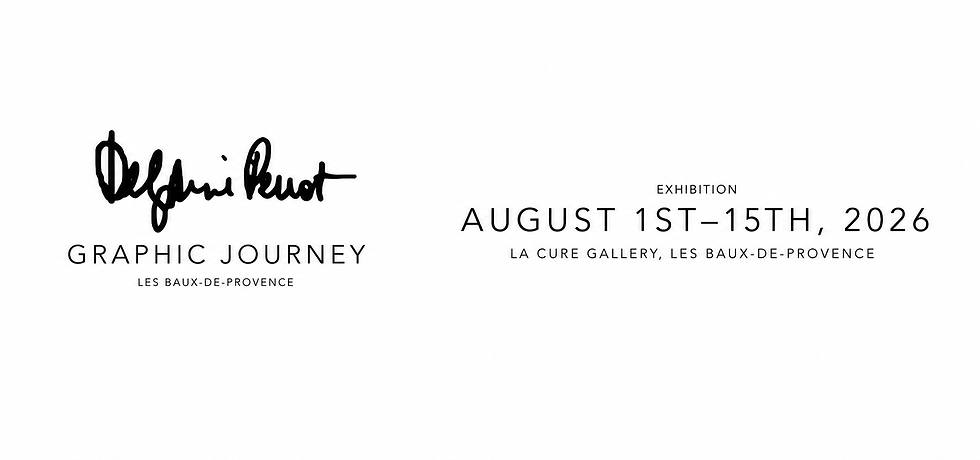
Contact Delphine Perrot contact@delphineperrot.com and view her art in Les Baux-de-Provence
from August 1st - 15th
References
Anfam, D. (1994). 1950 – 1961: Franz Kline Black and white Menil Collection.
La Varende, J. de. (1955). Saint-Simon. Editions du Rocher.
Merleau-Ponty, M. (1962). Phénoménologie de la perception (C. Smith, Trad.). Routledge. (Original work published 1945)
Merleau-Ponty, M. (1964). Translated from the French by C. Dallery (2016/2020) Eye and mind In J. M. Edie (Ed.) In The primacy of perception (pp. 159-190). Northwestern University Press. (Original work published 1961)
Merleau-Ponty, M. (1968). Published in the book The visible and the invisible A. Lingis (Trans.) Northwestern University Press.


Comments