
Politics, Power, and Performing Arts: Why Democracies Cannot Survive Without Culture I

Updated: Jun 15

Natalija Riabko
DBA and Director, HorizonVU Group
In the first installment of this two-part commentary, Natalija Riabko examines politics and the performing arts through a historical lens.
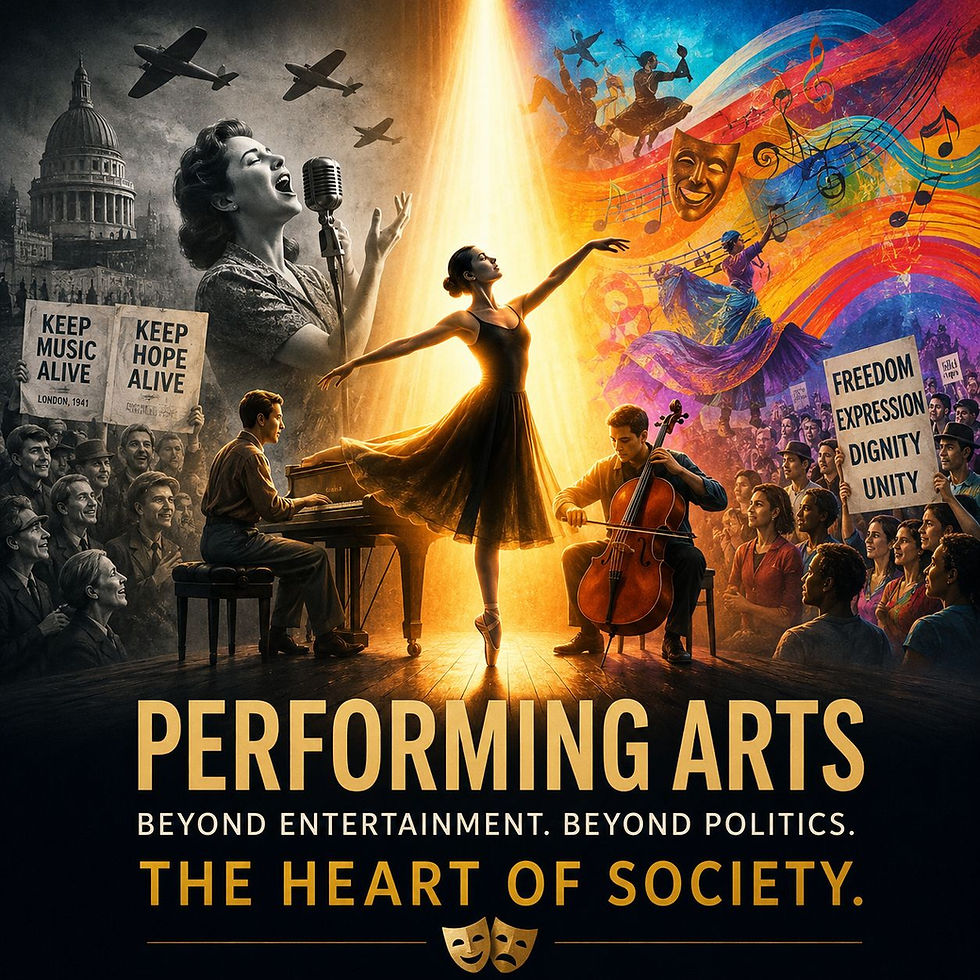
In moments of political crisis, societies often discover that performing arts are not a luxury. They are infrastructure for collective survival. Theatre, music, dance, cinema, opera, and live performance shape national identity, preserve memory, sustain morale during war, and create spaces where democratic dialogue can continue even when political systems fracture. Recent international reports from UNESCO and cultural policy researchers increasingly argue that culture is not peripheral to politics but central to democratic resilience, peacebuilding, and social cohesion.
The relationship between politics and performing arts has always been complex. Governments fund national theatres, regulate artistic freedom, use culture for diplomacy, and sometimes manipulate artistic production for propaganda. At the same time, artists often become the conscience of society, challenging authoritarianism and giving voice to populations living through fear, poverty, censorship, or war.

The most recent UNESCO Global Report on Cultural Policies stresses that cultural participation strengthens resilience during crises and helps societies preserve social trust. The report warns that weakening cultural institutions can weaken democracy itself because artistic spaces are among the few places where citizens collectively reflect on identity, justice, and the future.
History offers powerful evidence.
During the Second World War, performing arts played an extraordinary role in maintaining psychological resistance. In Britain, theatre productions, concerts, and radio performances continued even during the Blitz. The National Gallery in London famously organized lunchtime concerts while bombs were falling over the city. Music became a symbol of continuity and civilization against destruction. Winston Churchill himself reportedly rejected proposals to cut cultural funding during wartime, understanding that societies fighting only for physical survival eventually lose the moral reason for survival itself.

Across occupied Europe, theatre and music often became subtle forms of resistance. In France, artists used coded language and allegory to criticize Nazi occupation. In Poland, underground theatres operated illegally despite enormous risks. These performances were not entertainment alone; they preserved language, memory, and national identity under political oppression.
The United States also recognized the strategic importance of performing arts during wartime. Hollywood films, touring jazz musicians, and military entertainment programs helped sustain troop morale and public unity. Yet the role of arts was not limited to propaganda. Many wartime performances helped populations process grief and trauma collectively. Shared artistic experiences reminded citizens that human dignity still existed amid violence.
But the arts also repeatedly resisted political systems.
In South Africa during apartheid, theatre became a mechanism for confronting racial injustice. Plays by Athol Fugard and performances at venues such as the Market Theatre in Johannesburg exposed realities the political regime attempted to suppress. In Latin America during military dictatorships, music and street theatre preserved dissident voices when political speech was censored. In Eastern Europe, underground artistic networks helped sustain intellectual opposition to authoritarian governments throughout the communist period.
Recent political developments continue to demonstrate how closely governments associate artistic control with political power. Debates around cultural institutions, artistic freedom, and public funding have intensified globally. Analysts increasingly warn that attacks on artistic autonomy often accompany broader democratic erosion. A recent analysis in The Guardian compared political attempts to control major cultural institutions with historical authoritarian patterns, emphasizing how governments frequently seek influence over the arts because culture shapes public imagination and collective values.
Next month, in the next part of this two-part analysis, Natalija Riabko examines the enduring importance of the performing arts and the challenges that lie ahead. Watch for Part II at this site or announcements on social media.


Comments